


- Misdiagnosed: the REMS scan story
- What osteoporosis actually is
- The blood tests most doctors never order
- Best foods for bone health
- Hormones and HRT you are here
- Movement and exercise coming soon
- Emerging support and technology
Dr Franziska Meuschel, the London-based longevity physician I first introduced you to in Part Three, once put something to me that I have not been able to shake since. “Bone loss,” she said, “tracks oestrogen decline, and that decline can begin in the mid-late thirties, long before anyone is watching.”
Long before anyone is watching. That phrase has stayed with me through every part of this series. It is also, I think, the reason hormones are simultaneously the most powerful lever in this entire story and the one women are least equipped to discuss with confidence. Not because the evidence is thin. Because for twenty years, most of us were never given it.
When I was diagnosed with osteoporosis, with a T-score of -3.2, I knew almost nothing about the extraordinary relationship between hormones and bones. Like many women, I associated menopause with hot flushes, poor sleep and middle-aged spread. What I had never thought to connect to it was the longer list I had quietly put down to simply getting older: aching joints, the brain fog, the words that vanish mid-sentence, and for some the flat, grey mood that no amount of the antidepressants so readily reached for ever seemed to lift, only to numb. And I certainly did not realise that the most significant consequence of all could be unfolding silently, out of sight, inside the skeleton.
Having chatted amongst my friends and viewed numerous chat groups, I realised it wasn’t just me, but it seemed 99% of all women are in the dark about this subject. Which is why I have decided to do the research, since it isn’t explained in general by the national health service, your own GP or even our gynecologists, who both said, when questioned why there is a such a big gap in awareness, they just don’t have the time! Wow, when osteoporotic fractures affect 1 in 3 women over 50, I find this both concerning and frightening.
Why Oestrogen Is Bone’s Master Switch
I explained the basic mechanics of bone remodelling in Part Two: two cell types, osteoclasts breaking bone down and osteoblasts building it back up, locked in permanent renovation. What I did not explain there is the role oestrogen plays in keeping that renovation in balance.
Oestrogen is, in effect, the brake on the demolition crew. It restrains osteoclast activity, partly by suppressing a signalling molecule called RANKL. When oestrogen falls at menopause, that brake comes off. Resorption starts outrunning formation, and bone is lost fastest in the first few years after your final period. This is settled cell biology, not a fringe theory, and it is why the period immediately around menopause represents one of the single greatest windows of risk for accelerated bone loss in a woman’s life.
It is also why, of everything covered in this series so far, hormonal health may be the single biggest lever of all.
Oestrogen Was Never Just About Bones
It would be a mistake to close this chapter believing oestrogen is a bone hormone and nothing more. It is one of the reasons the work of Dr Shauna Watts, a GP and women's health advocate, has stayed with me: she widens the frame in a way this series needs. Bone loss, she reminds us, is only one chapter of a much longer story. Oestrogen was never simply a reproductive hormone to be discarded once your childbearing years are behind you. That, in her words, has been one of the great misunderstandings of modern women's healthcare.
Oestrogen is a brain hormone: it helps keep your thinking sharp, your memory intact and your mood level, which is why so many women describe their minds after menopause as wading through wet concrete, losing words mid-sentence and quietly fearing the worst. It is a metabolic hormone, governing where the body stores fat and how readily it burns it, which is why the weight settles stubbornly around the middle no matter how carefully you eat. As Dr Watts puts it, your body is not broken, it is responding entirely logically to an oestrogen-deficient environment. It is a sleep hormone, working alongside progesterone to hold you in deep, restorative sleep, so that the 4am waking so many of us know is less insomnia than deficiency. It lines and protects the bladder and vaginal tissue, which thin and inflame without it. And, as this series has laboured, it quietly protects your bones, silently, until one day something breaks that should not have.
The thread running through all of it is the one I keep returning to: almost everything we have been taught to file under “just getting older”, the aching joints, the fog, the flattened mood, has a physiological explanation underneath it. It is why Dr Watts is so scathing about the reflex to reach for an antidepressant, as she says, handing a woman antidepressants when what she needed was an oestrogen conversation. Low mood after menopause can be real and can need treating in its own right, but when a tablet leaves you numb rather than well, it is worth asking whether the deficiency underneath was ever addressed.
There was one idea in particular I had never encountered, and I have not stopped thinking about it since. Your brain, it turns out, never stops asking for oestrogen. A hormone called FSH, follicle-stimulating hormone, is the signal your brain sends to your ovaries to make it, a monthly conversation that has run since puberty. When the ovaries can no longer answer, the brain does not accept the silence, it sends the signal louder and louder, so that FSH in post-menopausal women can run some fifteen times higher than in their reproductive years. Dr Watts describes it, hauntingly, as a brain left permanently asking for something it never receives. What lifts this above poetry is the emerging research she points to: chronically elevated FSH appears to be independently associated with osteoporosis, cardiovascular disease, obesity and even Alzheimer's, the unanswered signal perhaps doing damage of its own. I want to be careful here, as I have tried to be throughout. This is an emerging and largely associational picture, not settled cause and effect. But it is a compelling reason to stop imagining menopause as a door that simply closes behind us.
Which brings me to the argument I have found hardest to unhear. We are forever told that menopause is natural, and therefore not to be treated. Yet a broken leg is natural, and we set it. An underactive thyroid is the natural consequence of a failing thyroid, and no one tells that woman to do more yoga and eat less sugar. Somewhere along the way we decided that the natural consequences of oestrogen deficiency were simply life. They were never simply life. They were, and are, a deficiency, and deficiencies have treatments.
I will add my usual note of caution. Dr Watts is a passionate advocate who runs her own programme, so hers is a strong voice with a point of view, and the science on some of this, the FSH link especially, is still maturing. But her central reminder is the one I want you to carry from this series: the bones I have written so much about are not a separate problem to be solved in isolation. They are one visible sign of a whole body that has been running, sometimes for decades, without something it was designed to have.
The 2002 WHI Earthquake, and What Actually Happened
To understand why so many women were never offered this lever, you have to go back to the Women’s Health Initiative, or WHI, a very large American trial launched in the early 1990s to test, among other things, whether HRT could protect older women from heart disease.

In 2002, the oestrogen-plus-progestin arm of that trial was stopped early. The headline that reached the public was blunt: HRT causes breast cancer. Prescriptions collapsed worldwide almost overnight. An entire generation of women came off HRT, or were never offered it in the first place.
There were two problems with that headline. The first was the trial population. The average participant was around 63, some with numerous pre-conditions, and many of them well over a decade past menopause. Not the symptomatic 50-something who typically starts HRT today. The trial had really answered the question “what happens if you start standard HRT in your sixties?”, and the answer was reported as though it applied to every woman, at every age, on every formulation.
The second problem was what got buried in the same study. The oestrogen-plus-progestin group also showed roughly 33% fewer hip fractures and around 24% fewer total fractures, with a similar reduction in the oestrogen-only group. HRT is one of the very few interventions ever shown to cut fractures in women who were not selected for high risk in the first place. That finding barely made the news.
Twenty years of follow-up data have since refined the picture further. The breast cancer signal was tied mainly to oestrogen combined with the synthetic progestin. Oestrogen alone, given to women who had already had a hysterectomy, showed no increase in breast cancer risk, and in later follow-up was actually associated with lower incidence and mortality. “HRT causes breast cancer” was always too crude a sentence. It depends enormously on the formulations and the individual.
I was reminded just how far that 2002 fallout reached while researching this piece, listening to an interview with Dr Kelly Casperson, a urologic surgeon who has become a prominent voice on women’s sexual health. She pointed out that the FDA’s black box warning, the alarming label listing dementia, blood clots, heart disease and stroke, was applied not just to systemic HRT but to every oestrogen product on the market, including low-dose vaginal oestrogen creams used purely for local tissue health, with no meaningful effect on the rest of the body. That warning stayed in place for roughly 25 years. It was only removed from labelling in late 2025. One study she cited found that around 30% of women who were given a prescription never filled it, purely because of what the box told them to fear. That is not an abstract statistic. That is two decades of women declining a treatment that, at that dose, was never the treatment the warning was written about.
The Window of Opportunity
The way the field has reconciled all of this is what is now called the timing hypothesis, or the window of opportunity. Starting HRT under 60, or within ten years of menopause, generally gives a favourable balance of symptom relief, bone protection and a neutral to favourable cardiovascular picture. Starting it much later, into arteries that have aged without oestrogen for one or two decades, shifts that balance the other way.
This is now the organising idea of mainstream menopause medicine, not a fringe position. The Menopause Society’s 2022 position statement states plainly that HRT has been shown to prevent bone loss and fracture, and that benefits outweigh risks for most healthy, symptomatic women under 60 and within ten years of menopause onset. It also notes that transdermal routes, patches and gels rather than tablets, and lower doses may reduce the risk of blood clots and stroke compared with oral oestrogen.
NICE’s UK guideline (NG23) goes further in one respect that I think deserves far wider attention: it tells clinicians to explain that the baseline population risk of fragility fracture around menopausal age is low, that fracture risk decreases while taking HRT, and, crucially, that this benefit is maintained during treatment but decreases once treatment stops. HRT protects bone while you are taking it. It is not a permanent fix you bank and walk away from.
Put simply: the practitioners’ long-standing complaint, that HRT is a powerful and underused bone tool, is now broadly supported by the mainstream guidelines, not opposed by them. The genuine remaining debate is narrower than the internet suggests: whether HRT should be offered primarily for bone protection in an otherwise asymptomatic woman (the guidelines are cautious here; it is generally positioned for symptomatic women, with bone protection as a major additional benefit), and how far past that ten-year window it remains sensible for an individual.
Is it ever really "too late"?
If you are reading this having been told, after your own osteoporosis diagnosis, that HRT is no longer an option for you, that you are too old, too many years past menopause, or that it is simply too dangerous now, I want you to keep reading, because that verdict deserves a second look.

It is a point made forcefully by Dr Doug Lucas, the orthopaedic surgeon turned longevity physician whose work I have drawn on throughout this series. He highlights something that genuinely surprised me: the guidelines born out of the 2002 WHI panic never actually said HRT should be withheld from women over 60, or more than ten years past menopause. They said the benefits most clearly outweigh the risks for symptomatic, otherwise-healthy women within ten years, and that beyond that, a woman's individual risk factors should be weighed. Somewhere along the way, "weigh it carefully" hardened into "don't offer it at all," and, as he puts it, an entire generation of women were quietly denied care as a result.
His clinical argument is a hopeful one. Look at the long-term follow-up data rather than the frightening early headlines, and the heavy risks that were reported either faded over time or turned out to belong to the older, synthetic formulations used in the trial, not to HRT as a category. For a woman in her sixties, he argues, starting HRT today is not riskier than doing nothing, and once osteoporosis is on the table, the whole equation shifts. The rare risk of a clot has to be set against the very real risk of a hip fracture, a lost independence, a fractured spine. His words are the ones I keep coming back to: "A diagnosis of osteoporosis isn't the end. Deciding to reverse it is a beginning."
I want to stay careful here, as I have tried to be all the way through this series. Dr Lucas is candid that he views these things differently from many doctors, and his enthusiasm for HRT in older women runs somewhat ahead of where the cautious mainstream guidelines currently sit. This is not a green light to demand a prescription, and it is emphatically not a decision to make without a doctor willing to look properly at your own arteries, your own bloodwork and your own medical history. But it is permission to ask the question, and to expect a real conversation rather than a door closed before it has opened. If you would like to hear him make the full case in his own words, his video is well worth twenty minutes of your time. Dr Doug Lucas, Understanding HRT and Menopause (YouTube)
What My Practitioners Say, and Where They Run Ahead of the Evidence
Several of the specialists I have consulted across this series have strong, consistent views on HRT and bone.
Dr Doug Lucas, the orthopaedic-surgeon-turned-longevity physician whose work has informed much of this series, calls HRT one of the most powerful preventive tools available to postmenopausal women, and argues it remains grossly underused given the strength of the evidence behind it. His frustration, echoed by others I’ve referenced in this series, is with a system fixated on density scans and drugs while largely ignoring hormonal status.
Dr Franziska Meuschel, characteristically, is the most carefully balanced voice on this. She does not take HRT herself, and works with a natural approach for her own health, but is clear that she recommends it for patients whose risk profile warrants it. Her words to me were simple: it is a decision made per woman, not per ideology. She would, she said, be a poor doctor if she let her own personal choices dictate her patients’ care. (This is such a big topic that a natural approach to menopause will be covered in a future article).
“This is a decision made per woman, not per ideology.”Dr Franziska Meuschel
Jill Ritchie, the certified trainer whose bone-building framework I have also drawn on, lists HRT as one of her six foundational pillars, citing the WHI’s roughly 24% reduction in fractures and describing HRT as being as effective as some bone medications, without the same long-term breakdown-related side effects. Like every credible voice in this space, she caveats it firmly: not suitable for everyone, and a conversation to have with your own doctor.
Where I think it is only fair to flag a gap: several of these practitioners are also enthusiastic about testosterone in women for bone and muscle benefit, beyond its role in libido. That enthusiasm runs somewhat ahead of the guidelines. The British Menopause Society’s position is that testosterone in women is licensed thinking for low libido after other options have been tried, at a female physiological dose, and it does not currently claim a bone or muscle indication. The mechanism is plausible, and it is an active area of research, but it is not yet where the mainstream evidence sits.
Something all women want to know, oestrogen for the face, does it work?
Here is an intriguing little addition to the hormone story. Oestrogen receptors are also found in the skin, and falling levels contribute to reduced collagen, hydration, thickness and elasticity.
Small studies of topical facial oestrogens have reported improvements in skin thickness, firmness and fine lines. However, the research is short-term and inconsistent, long-term breast and endometrial safety is not established, and products prescribed for vaginal use have not been tested or approved as facial skincare. Possible concerns include systemic absorption, irritation and melasma or other pigmentation.
Some dermatologists prescribe carefully formulated facial oestrogen selectively; others believe the evidence remains insufficient. For now, it is an interesting emerging field to discuss with an appropriately qualified clinician, not an invitation to put vaginal oestrogen cream under our eyes without medical guidance.
Beyond Oestrogen: The Rest of the Hormonal Switchboard
And it is always important to remember that whilst oestrogen is the headline, but it is not the only hormone that matters.

Thyroid. Thyroid hormone sets the pace of bone remodelling, and the honest message here cuts against the “just optimise your thyroid” enthusiasm you sometimes hear in longevity circles. Under-treated hypothyroidism is genuinely bad for bone. But over-replacement with thyroxine, pushing your TSH too low, is an established, independent risk factor for lower bone density and fracture, particularly after menopause. The target here is right, not high. If you are on thyroxine and your TSH is persistently low, that is a legitimate question for your doctor, not a reason to push the dose up further.
Cortisol. Cortisol is catabolic to bone. It suppresses the bone-building osteoblasts, extends the lifespan of the bone-breaking osteoclasts, and reduces calcium absorption. Glucocorticoid-induced osteoporosis, caused by long-term steroid medication such as prednisone, is the single most common cause of drug-induced bone loss, roughly doubling spine and hip fracture rates. Exercise physiologist Dr Stacy Sims makes the same point about everyday, endogenous cortisol: fasted training and prolonged fasting in women keep the morning cortisol spike elevated, and the body responds by breaking down lean mass, including bone, alongside muscle. Her own words for it: she does not want your bones to be like chalk. I want to be fair to the evidence here. The fracture data for pharmaceutical steroids is well established. The evidence that everyday stress alone causes fractures is softer, a plausible mechanism rather than a proven one, so I am reporting it as exactly that.
Parathyroid hormone and vitamin D. I introduced vitamin D, PTH and CRP as blood markers worth requesting in Part Three. Here is the mechanism behind why PTH matters so much. It is your body’s calcium thermostat. When blood calcium dips, often driven by low vitamin D, low calcium intake or low magnesium, PTH rises and pulls calcium out of your bones to protect your blood levels. Chronically elevated PTH, known as secondary hyperparathyroidism, is an under-discussed driver of bone loss in older, vitamin D deficient women, and a simple calcium and PTH blood test can catch it. There is a genuinely elegant paradox buried in this hormone: continuous high PTH strips bone, but the same hormone delivered in short, intermittent pulses is anabolic, building new bone. It is the basis of the osteoporosis drug teriparatide. Biology, in this case, is entirely a matter of dose and rhythm.
Long-term glucocorticoid medication is a well-established cause of osteoporosis, while genuine disorders of cortisol excess can also damage bone. This is not the same as claiming that an ordinary stressful week causes osteoporosis, although chronic stress may indirectly affect sleep, nutrition, alcohol use and exercise.
Insulin resistance and poor metabolic health are also relevant. People with type 2 diabetes may have apparently normal or even higher bone density yet still experience increased fracture risk, reminding us again that denser bone is not necessarily stronger bone.
DHEA. This adrenal hormone, which the body converts into both oestrogen and testosterone and which naturally declines with age, is popular in anti-ageing circles as a bone and muscle supplement. The evidence is weak and mixed: some small trials show modest bone density gains, more consistently in women than men, and there is observational data linking higher natural DHEA levels to better spine bone density. But the randomised trials are small, short and inconsistent, with no fracture-outcome data at all, and menopause society guidance does not currently endorse it for bone. Biologically plausible, commercially popular, evidentially thin. Not a substitute for anything proven.
A Note on Testing: Where the DUTCH Test Fits
Since Part Three, several readers have asked me about the DUTCH test, the Dried Urine Test for Comprehensive Hormones, which has been getting considerable attention in wellness circles.

It is a genuinely interesting tool. Rather than a single blood draw, you collect four or five dried urine samples across 24 hours, which are then analysed for more than 35 hormones and metabolites, including how your body breaks oestrogen down into its various metabolite pathways, and a fuller picture of your cortisol rhythm across the day than a single blood test can offer.
Once again, on anything not devised by the mainstream medical profession, there are conflicting views. Thus the Menopause Society’s 2022 position statement is explicit that saliva and urine hormone testing to guide HRT dosing is unreliable and not recommended for routine use. The DUTCH test’s own primary validation research was also conducted by researchers connected to the company that makes it, and independent, large-scale clinical trials are still lacking. It also cannot diagnose menopause, PCOS or thyroid conditions, and results genuinely need an experienced practitioner to interpret, since reference ranges are lab-specific.
However there are many holistic practitioners who maintain that, within their own client base, it makes a genuine difference. Particularly where it may add genuine value is for women with persistent, unexplained symptoms and issues with HRT, despite normal standard bloodwork, particularly around cortisol and adrenal patterns, and as a complementary layer of information rather than a replacement for the P1NP, CTX, vitamin D, PTH, CRP and estradiol panel I outlined in Part Three. Think of it as one more data point for a good practitioner to weigh, not a verdict in itself. It is also a test only available privately.
The Risks, Handled Like an Adult
I do not want to close this chapter without stating plainly what the honest risk picture looks like, because pretending there is no downside would be its own kind of dishonesty.
Breast cancer risk is real, however where it exists, appears tied mainly to oestrogen combined with older synthetic progestins, not so much to oestrogen alone, and does not increase appreciably with short-term use. Micronised progesterone appears more favourable than older synthetic progestins on this point, though the long-term randomised data for it is still thinner than we would like. Transdermal oestrogen, patches and gels, carries a lower blood clot and stroke signal than oral tablets, a distinction the mainstream guidelines now accept as fact rather than alternative opinion. The fact is that HRT, like every medical intervention with real biological effect, is genuinely not suitable for every woman. None of this is a reason to dismiss it for all women. It is the reason the conversation needs to happen properly, with your own risk factors on the table, rather than being shut down before it starts.
A Decision, Not a Default
If there is one sentence I would want every woman reading this series to carry into her next doctor’s appointment, it is Dr Meuschel’s. This is a decision made per woman, not per ideology.

Not a decision made by a headline from 2002. Not a decision made by a doctor’s personal preference, in either direction. Not a decision made by fear of a label that, in the case of vaginal oestrogen, was applied for a quarter of a century. A decision made by you, armed with your own risk factors, your own symptoms, your own bone density, and a doctor willing to have the fuller conversation.
That is the question I am still asking of my own doctors, T-score by T-score, appointment by appointment. I suspect I am not alone in that.
Key Takeaways
- Oestrogen is the brake on bone breakdown. When it falls at menopause, bone is lost fastest in the first few years after your final period.
- The 2002 WHI scare was misread. The risk sat mainly with older synthetic progestins and an older trial population, while the study's 33% drop in hip fractures barely made the news.
- Timing matters. Starting HRT under 60, or within ten years of menopause, gives the most favourable balance, and HRT protects bone only while you are taking it.
- Being over 60 is not an automatic 'too late'. The guidelines never barred it; individual risk factors, not age alone, should decide.
- How you take it counts. Transdermal HRT, patches and gels, carries a lower clot and stroke signal than tablets.
- It is a decision made per woman, not per ideology. Bring your own risk factors, symptoms and bone density to the conversation.
I would love to hear from you: were you offered HRT around menopause, or were you told it was too late? And if you have navigated this conversation with your own doctor, what helped you feel truly heard?
Further Inspiration: what osteoporosis actually is · the bone blood markers most doctors skip · the best foods for your bones after 50

As featured in the Mallorca Bulletin
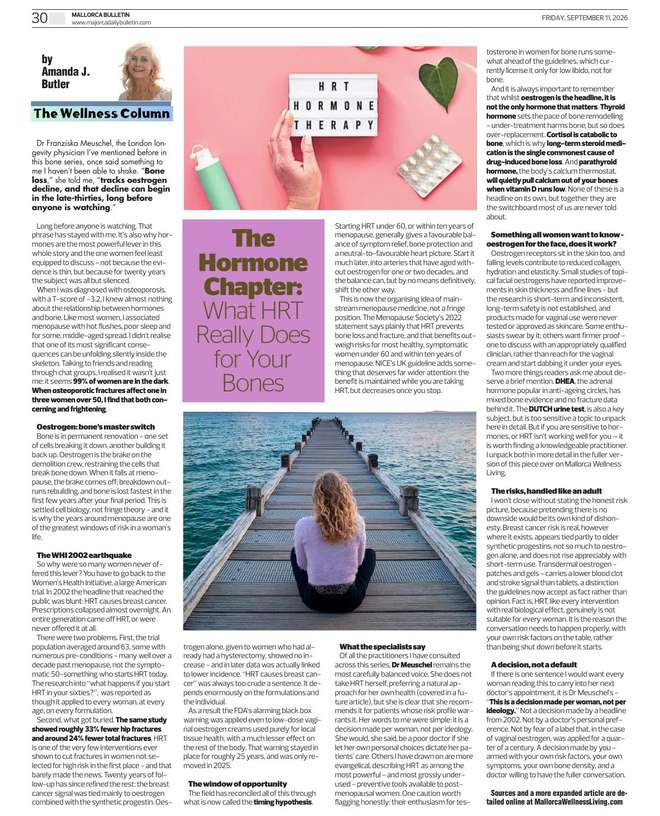
A shorter version of this article first appeared in Amanda’s Wellness Column in the Mallorca Bulletin. Read the original as a PDF →
Sources and Further Reading
I have leaned on regulators, menopause and endocrine societies, peer-reviewed studies and the named practitioners themselves, rather than the more sensational corners of the internet.
- The 2022 Hormone Therapy Position Statement. The Menopause Society (NAMS), 2022.
- Menopause: identification and management (NG23), Recommendations. NICE, 2024.
- BMS Statement on Testosterone. British Menopause Society, 2023.
- Menopausal Hormone Therapy and Breast Cancer Incidence and Mortality: long-term follow-up of the WHI randomised trials (Manson et al.). JAMA, 2020.
- Then and Now: What We Have Learned From the WHI. Journal of Clinical Endocrinology & Metabolism, 2026.
- The mechanisms of estrogen regulation of bone resorption (Riggs). Journal of Clinical Investigation, 2000.
- Estrogen Regulates Bone Turnover by Targeting RANKL Expression. Scientific Reports, 2017.
- Risk of venous thrombosis with oral versus transdermal estrogen therapy among postmenopausal women. 2010.
- The impact of micronized progesterone on breast cancer risk: a systematic review. Climacteric, 2018.
- Evaluation and Management of Bone Health in Patients with Thyroid Diseases: Position Statement. Endocrinology and Metabolism, 2023.
- Levothyroxine and Bone (70 Years of Levothyroxine). NCBI Bookshelf.
- An Overview of Glucocorticoid-Induced Osteoporosis. Endotext, NCBI Bookshelf.
- Glucocorticoid-induced osteoporosis: novel concepts and clinical implications. Lancet Diabetes & Endocrinology, 2025.
- Vitamin D deficiency and secondary hyperparathyroidism in the elderly: consequences for bone loss and fractures. 2001.
- Secondary Hyperparathyroidism. StatPearls, NCBI Bookshelf.
- Endogenous DHEAS Is Causally Linked With Lumbar Spine BMD and Forearm Fractures in Women. Journal of Clinical Endocrinology & Metabolism, 2022.
- Dehydroepiandrosterone and Bone Health: Mechanisms and Insights. Biomedicines, 2024.
- Understanding HRT and Menopause (Dr Doug Lucas). YouTube.
- Why Post-Menopause Women Are Being Left Behind (Dr Shauna Watts, All About You podcast). YouTube.
Frequently Asked Questions
Does HRT really protect your bones?
Yes. It is one of the few treatments ever shown to cut fractures in women who were not selected for high risk, and both the Menopause Society and NICE now say plainly that it prevents bone loss and fracture. The important caveat is that the benefit is maintained while you are taking it and fades once you stop, so it is not a fix you bank and walk away from.
Is it ever too late to start HRT after menopause?
Being over 60, or more than ten years past menopause, is not an automatic no. The original guidelines never barred it; they asked doctors to weigh individual risk factors. The most favourable window is under 60 or within ten years of menopause, but for many older women, especially with osteoporosis, it remains a conversation worth having rather than a door that should be closed.
Did the 2002 WHI study prove HRT causes breast cancer?
Not in the way the headline suggested. The signal was tied mainly to oestrogen combined with an older synthetic progestin, in a trial population averaging around 63. Oestrogen alone, in women who had had a hysterectomy, showed no increase, and in later follow-up was linked to lower incidence. The risk depends enormously on the formulation.
Are HRT patches safer than tablets?
For blood clots and stroke, transdermal oestrogen, meaning patches and gels, carries a lower signal than oral tablets. This is now accepted by the mainstream guidelines rather than treated as alternative opinion. Which route suits you is still a personal decision to make with your doctor.
Is the DUTCH test worth doing?
It is an interesting tool that maps your cortisol rhythm and oestrogen metabolites in more detail than a single blood draw. However, the Menopause Society does not recommend urine hormone testing to guide HRT dosing, and independent large-scale validation is still lacking. Treat it as one extra data point for an experienced practitioner to weigh, not a verdict in itself, and note that it is only available privately.
Can HRT reverse osteoporosis?
HRT protects and helps build bone while you take it, and several specialists rate it as highly as some bone medications. It is best thought of as one powerful pillar within a wider plan, alongside nutrition, resistance exercise and the right bloodwork, and it is genuinely not suitable for every woman.
Beyond HRT, what natural steps support bone health?
A great deal helps: weight-bearing and resistance exercise, enough protein, calcium, magnesium and vitamin D, sensible sunlight, and keeping stress and cortisol in check. These foundations matter whether or not you choose HRT, and they are covered in more detail across the rest of this bone health series.
Disclaimer: Amanda is a wellness writer, not a medical professional. This article is for general information only and is not medical advice, and the research behind it is linked in the Sources above for you to explore. Always talk to a qualified healthcare professional about your own situation before making any changes, as individual needs vary.

An extremely well researched and informative article
Many thanks for your kind words
Very balanced and informative article. I am enjoying your bone health series!
Thank you
That’s great to hear – please share with all your community