


- Misdiagnosed: the REMS scan story
- What osteoporosis actually is
- The blood tests most doctors never order you are here
- Best foods for bone health
- Hormones and HRT
- Movement and exercise
- Emerging support and technology
OSTEOPOROSIS: PART THREE
The Gap Nobody Talks About
Drugs, diagnostics, and what the system has left behind
When my osteoporosis diagnosis arrived - with a T-score of -3.2 - following what had thought was merely a precautionary DEXA scan, having gone to my doctor for a swollen finger - my reaction was mixed - shock, horror, disbelief. The horror came from not knowing what the diagnosis really meant. The disbelief came from feeling that it simply didn't fit the life I had been living.
Just a year earlier, I had come off my road bike approaching a T-junction, somersaulting clean over the handlebars. Apart from one small fracture where the handlebar struck my ribcage, I walked away remarkably unscathed. If my bones really were at the severe end of osteoporosis, I struggled to understand how I had escaped with so little injury.
Until that moment, osteoporosis belonged to someone else's story - not mine. I considered myself fit, healthy and strong. That single question - if my osteoporosis was so severe, why didn't more break? - became the start of a six-month investigation.
It led me into the medical literature, conversations with doctors from different disciplines, and interviews with clinicians who have dedicated their careers to understanding bone health. Among them was Dr Franziska Meuschel, founder of More Than Health, a London-based physician specialising in longevity and metabolic medicine, with a particular clinical interest in osteoporosis prevention.

When my diagnosis was confirmed, I was referred not to an osteoporosis specialist but to a rheumatologist. Rheumatologists are experts in autoimmune and inflammatory joint diseases, and many care for patients with osteoporosis, particularly when it occurs alongside these conditions. But they are not dedicated specialists in bone metabolism or longevity medicine. For me, that distinction mattered.
The more I learned, the more one question kept resurfacing - if osteoporosis affects one in three women over fifty - and osteopenia one in two - why are there so few doctors whose sole focus is bone health?
Osteoporosis is the silent architecture behind millions of fractures, loss of independence and premature mortality worldwide. Although around 80% of diagnosed cases are in women, men are affected too. Yet despite its enormous impact, dedicated osteoporosis specialists remain surprisingly scarce within publicly funded healthcare systems.
What does exist, almost without exception, is a prescription pad.
That is not because doctors don't care. It is because the system has evolved around the evidence available to it.
Much of the research that underpins conventional osteoporosis treatment has been funded by the pharmaceutical industry. This is not a conspiracy-it is economics. There is little commercial incentive to invest millions researching resistance training, nutrition or hormone optimisation. There is, however, a clear incentive to demonstrate the effectiveness of medicines.
The result is a healthcare model that often reaches for medication before every other lever has been fully explored.


Meanwhile, many of the practitioners pushing the boundaries of bone health - using advanced blood markers, personalised nutrition, hormone optimisation, resistance training and targeted supplementation - work largely outside mainstream medicine. Their work is often conducted in private practice and receives far less institutional funding or recognition than pharmaceutical research.
This is the gap nobody talks about.
It isn't a battle between conventional and functional medicine. It's a wide gap in knowledge, diagnostics and prevention. And every year, millions of women unknowingly fall into it.
What follows is a guide to the diagnostic tools, treatment options and emerging evidence that can help you ask better questions - and take a more informed role in your own bone health.
Is Your DEXA Scan as Accurate as You Think?
The gold standard diagnostic tool, the DEXA scan, is a bone-density X-ray - typically recommended only every 24 months. Not only because bone changes slowly, but because the scan's own margin of error means smaller changes simply cannot be distinguished from measurement noise. By the time a DEXA reflects what you have been doing, you are already eighteen months into either success or failure.
There is also a growing body of evidence - and a growing conversation among specialists - about how much margin for error this scan actually carries. The officially cited precision error sits at around 2%. In clinical practice, once you factor in different machines, different technicians and variations in patient positioning, the real-world figure for minimum detectable change is closer to 6%. Dig deeper into specialist podcasts, peer-reviewed literature and osteoporosis patient communities, and there is a compelling case that the true misclassification rate is higher still.
In my own case, 6 six months after my original diagnosis, a trip to the UK for a REMS scan - the ultrasound-based technology that assesses bone structure rather than density alone (since there wasn't one available in the Baleraics where I live) - found something different from my DEXA result entirely. Where the DEXA had indicated osteoporosis with a T-score of −3.2, the REMS suggested osteopenia, with a low risk of fracture. A significant distinction. It was also striking to me that the doctor never raised the possibility of a margin for error. Which leaves a question I still think about: how many women simply accept their DEXA result as settled fact, start the medication they are handed, and never think to question whether the result even reflects who they are?
The Margin of Error Most Doctors Don't Mention
The scan's accuracy also depends heavily on what it has to work with. Scoliosis - curvature of the spine - causes overlapping bone in the curve that artificially inflates spine density readings. Women with scoliosis are frequently told they have normal or even good spinal bone density when they may not, and vice versa. Arthritis, spinal calcification and previous fractures can all distort readings in similar ways, a point confirmed by both Dr Andy Bush and Dr Wendy Warner, an American specialist who has focused specifically on these structural scanning errors. Patient positioning on the day, and whether the machine has been properly calibrated, add further variables.
There is also a built-in bias that is rarely mentioned. The DEXA reference database against which your result is measured was built around an average-sized woman - approximately 1.7m (5ft 6in), around 65kg. If you are petite, or very slim, your result will sit statistically further from that average regardless of your actual bone health. Small-framed women are consistently more likely to be flagged as at-risk than their bone structure warrants. This is an article in itself - but it belongs in this one, at least as a note of caution.
The Blood Markers That Reveal Real-Time Bone Health
There is a faster way to know what is happening in your bones right now. Two blood markers, rarely requested in routine practice, provide a real-time picture of bone metabolism - and between them, they answer the question a DEXA cannot: is bone actively building, holding steady, or being lost?
What Is P1NP?
P1NP (procollagen type 1 N-terminal propeptide) is released by osteoblasts - your bone-building cells - as they produce new bone. It is your bone-formation activity marker: a measure of how busy the construction crew is. P1NP rises in response to anabolic therapies, weight-bearing exercise and hormonal optimisation, making it one of the most useful tools for tracking whether your treatment is actually working.
What Is CTX?
CTX (C-telopeptide of type I collagen) is released when osteoclasts break down existing bone. It reflects bone resorption - the demolition side of the equation. CTX has a strong diurnal rhythm: it peaks between roughly 1:30 and 4:30 in the morning, sitting 40 to 60% above the 24-hour mean, and reaches its lowest point between 11am and 3pm. For accurate, comparable results, CTX must be drawn fasting, in the morning, ideally between 7 and 9am.
The P1NP:CTX Ratio - What the Numbers Actually Mean
What matters clinically is not either marker in isolation, but the ratio between them: P1NP divided by CTX. This indicates whether your bone metabolism is leaning toward building or breakdown. Research across more than 1,200 patients at The Canberra Hospital and Australian National University Medical School (Fisher et al., 2018) established practical threshold zones, developed further by functional medicine practitioners including Dr Doug Lucas:
| P1NP:CTX Ratio | Zone | What It Means |
| Below 100 | High Risk | Urgent attention - active bone loss |
| 100 - 130 | Uncertain | Close monitoring recommended |
| 130 - 150 | Stable | Bone loss arrested |
| Above 150 | Building | Bone formation active |
| Above 200 | Strongly Anabolic | Optimal - strongest building signal |
This ratio allows clinicians to track whether treatment is working. It's especially valuable for people using lifestyle interventions (nutrition, exercise, supplements, etc.) because they provide relatively rapid feedback months before a DEXA or even a REMS scan can detect any change - making it among the most actionable tools in osteoporosis management.. For people on osteoporosis medications, the markers remain informative but may be altered by the drugs, reducing the need for repeated testing.
How to Get Accurate Results
Precision matters. CTX should be measured under consistent conditions, ideally with a fasting morning blood draw at the same time of day and under similar circumstances (such as hormone timing, menstrual cycle phase, and sleep pattern), because CTX varies throughout the day. Use the same laboratory for every retest - P1NP results from different labs can differ by up to 50 points for the same patient, making longitudinal comparison meaningless if you switch. Stop biotin supplements and collagen peptides at least 48 hours before the draw, as both interfere with immunoassay accuracy. To obtain reliable results, This is why some doctors dismiss these tests as unreliable: not because the science is weak, but because, done inconsistently, the readings cannot be meaningfully compared.
The Six Blood Tests to Ask Your Doctor About
P1NP and CTX are only part of the picture. Ask your doctor about all six of the following - together, they provide a far more complete metabolic picture of bone health than any single result:
- P1NP - bone formation activity (the building rate)
- CTX - bone resorption rate (the breakdown rate)
- Vitamin D (25-OH) - essential for calcium absorption and bone mineralisation. "Within the normal range" is not the same as optimal for bone health; aim for a therapeutic level, not a statistical one
- Parathyroid hormone (PTH) - regulates calcium metabolism. Chronically elevated PTH accelerates bone loss, often signalling vitamin D insufficiency
- C-reactive protein (CRP) - systemic inflammation is a driver of bone breakdown and is routinely overlooked in standard bone assessments
- Estradiol - oestrogen is the key regulator of bone turnover. Its decline through perimenopause is the primary trigger of accelerated bone loss in women
Beyond the DEXA Scan: Understanding Bone Quality, Not Just Density
Why DEXA Doesn't Tell the Whole Story
The DEXA scan measures bone mineral density - how well your bone blocks an X-ray beam. It says nothing about internal architecture, the structural framework that actually determines whether bone holds firm under stress or fractures. Orthopaedic surgeon Dr Andy Bush, who describes his career as moving from "fracture fixation to fracture prevention", offers the clearest explanation:
“You can do a DEXA on a piece of chalk. Chalk is four times denser than wood. But nobody builds houses out of chalk - it's structurally useless. Wood is less dense but structurally strong. Dense does not mean strong.” - Dr Andy Bush, Orthopaedic Surgeon
It is also worth noting that 50% of fractures happen in women who do not have an osteoporosis diagnosis - their T-scores would never have flagged them as high risk. DEXA's structural blind spot accounts for much of that gap.
REMS - Scanning for Bone Quality
REMS (radiofrequency echographic multi-spectrometry) uses ultrasound rather than X-rays to assess bone quality - the internal architecture that determines real-world fracture risk. Currently oly available privately, it can also detect meaningful change faster than DEXA: six to twelve months versus twelve to twenty-four. This makes it particularly useful for monitoring treatment response between DEXA appointments.

Dr Meuschel is clear that REMS complements DEXA rather than replacing it: "What I object to is not DEXA. It is the idea that one number, from one tool, is a verdict. When instead it should be the beginning of a conversation."
FRAX - Your 10-Year Fracture Risk Calculator
The FRAX calculator (fraxplus.org) combines your bone density score with age, weight, previous fractures, family history and other risk factors to estimate your ten-year probability of a major fracture. A T-score of -2.5 in a healthy, active 55-year-old is a very different clinical situation from the same score in a frail 75-year-old who has already had a wrist fracture. FRAX makes that distinction - and it is free to use online.
Your Guide to Osteoporosis Medications
Your Guide to Osteoporosis Medications
If your doctor recommends medication, it is important to understand the two main approaches - why the order in which they are used matters, and what the side effects are that you may not have been told about.
Antiresorptive Drugs - Slowing Bone Breakdown
Bisphosphonates - including alendronate (Fosamax) and risedronate (Actonel) - are the most widely prescribed osteoporosis drugs. They slow the activity of osteoclasts, reducing the rate at which bone is broken down. They have an important role, but are not intended as lifelong treatment. Over time, they suppress bone remodelling to the point where the skeleton loses its ability to repair everyday microfractures naturally - which is both why a "drug holiday" is recommended after three to five years, and why atypical femur fractures are a recognised risk with prolonged use.

There are practical side effects worth knowing about. Bisphosphonates can cause significant oesophageal irritation and ulceration - they must be taken standing upright with a full glass of water, with no lying down for at least 30 minutes afterward. Many women stop taking them because of this, often without understanding why the instructions matter. Less commonly but more seriously, they are associated with osteonecrosis of the jaw - a condition in which jaw bone fails to heal, particularly after dental extractions. If you are on bisphosphonates, always tell your dentist; some will not perform extractions without specialist guidance.
Prolia (denosumab) is more potent but carries its own important caveats. Stopping it abruptly can trigger rapid rebound bone loss that may exceed the loss being treated - this is not a drug to simply stop taking without a carefully managed plan. It also suppresses a pathway involved in immune function, which means a small but documented increase in serious skin infections. Like bisphosphonates, it carries a risk of osteonecrosis of the jaw.
Anabolic Drugs - Building New Bone
Anabolic drugs stimulate osteoblasts to produce new bone rather than simply slowing breakdown. These include teriparatide (Forteo), abaloparatide (Tymlos) and romosozumab (Evenity). Generally reserved for more severe cases due to cost, some clinicians argue they may be more effective when introduced earlier in significant bone loss. Emerging evidence also suggests that beginning with antiresorptive drugs first may reduce the response to anabolic therapy introduced later - making treatment sequencing an increasingly important conversation to have.
Each of these drugs has side effects that deserve transparency. Evenity carries a black box cardiovascular warning in the US - an increased risk of heart attack and stroke - and is contraindicated in anyone who has had a recent cardiac event. This is rarely mentioned in general coverage of the drug. Forteo and Tymlos come with a historical osteosarcoma caution, based on high-dose rat studies; the clinical evidence in humans has not established this risk and the warning has been removed or significantly caveated in many countries, but it drove a two-year usage cap that still applies in most prescribing guidelines.
Dr Meuschel offers a measured summary of where medication sits in the broader picture:
"Drugs have a place. But in an ideal world they would not be prescribed before looking seriously at nutrition, movement, hormones and vitamin D status." - Dr Franziska Meuschel, More Than Health
Hidden Bone Thieves - Medications That Quietly Damage Your Skeleton
Some of the most significant threats to bone health come inside a prescription. Before beginning any treatment for osteoporosis, it is worth reviewing whether existing medications are part of the problem.
Proton Pump Inhibitors (PPIs)
Acid-suppressing drugs - including omeprazole, lansoprazole and pantoprazole - are among the most prescribed medications in the UK. Stomach acid is essential for mineral absorption, particularly calcium. Long-term PPI use (beyond two to three years) has been linked to a meaningful increase in hip fracture risk - around 20 - 25% across several UK analyses, with the figure rising substantially with duration of use. If you take a PPI regularly, ask whether the original indication still applies and whether the dose can be reviewed.
SSRIs and Antidepressants
SSRIs and SNRIs - antidepressants frequently prescribed for menopausal symptoms - also affect bone metabolism. Serotonin receptors are present on both osteoblasts and osteoclasts; excess serotonin disrupts both the bone-building and bone-remodelling cells. A 2024 UK study of of nearly 300,000 menopausal women found that the first month of SSRI or SNRI use was associated with a 38% increase in fracture risk, rising to 58% over the following two months; women taking them for menopausal symptoms specifically showed up to 70% higher risk. The mechanism: excess serotonin disrupts both bone-building and bone-breaking cells simultaneously.This does not mean these medications should be avoided - but the bone impact should be part of the prescribing conversation. It's definitely worth asking your integrative doctor if there are any more natural alternatives.
Corticosteroids
Long-term use of systemic corticosteroids - including prednisone and hydrocortisone - is among the most significant drug-related threats to bone health. Research shows prolonged use can more than double the risk of spinal and hip fractures over time. Corticosteroids suppress osteoblast activity directly while also reducing calcium absorption in the gut and accelerating calcium loss via the kidneys. If you are on long-term steroid therapy, bone-protective medication should be part of your care plan.
Smoking also reduces bone density substantially. And more than two units of alcohol per day interferes with calcium absorption and suppresses osteoblast function.
GLP-1 Weight Loss Drugs - A Warning Your Doctor May Not Have Given You
The rapid rise of GLP-1 receptor agonists - semaglutide (Ozempic/Wegovy) and tirzepatide (Mounjaro) - has transformed weight management. The effect on bone has received far less attention.
Dr Meuschel describes the situation as "a ticking time bomb." The concern is grounded in mounting evidence. Clinical data shows that more than sixty percent of people taking these drugs fall below minimum requirements for calcium and vitamin D, with vitamin D intake averaging around twenty percent of the recommended level. The SELECT trial - a large randomised study of over 17,000 participants - found that women on semaglutide had a five-fold higher rate of hip and pelvic fractures compared to placebo: 1% versus 0.2%. Separately, a 52-week randomised trial found that semaglutide increased bone resorption markers and reduced bone density at both the hip and lumbar spine, with no compensating rise in bone formation.
A significant part of the mechanism involves muscle loss. Approximately 25 to 40% of the weight lost on GLP-1 drugs is lean tissue - muscle, not fat. Muscle is what pulls on bone and signals it to keep building. Lose the muscle, and the building signal disappears. Crucially, research comparing drug-only weight loss to weight loss combined with exercise found that exercise prevented bone loss entirely - with the same overall weight reduction. The drug-only group lost bone at the hip and spine; those who exercised did not.
“Millions of women who are losing weight are also at risk of losing bone silently, and nobody is measuring it. If we ignore these warning signs now, we may find ourselves facing the consequences years down the line.”
Dr Franziska Meuschel, More Than Health
If you are taking or considering a GLP-1 drug, ask about a baseline bone assessment before starting - and treat resistance exercise as part of the prescription, not an optional extra.
Questions to Take to Your Next Appointment
None of this is an argument against mainstream medicine. It is an argument for arriving better equipped. At your next appointment, consider asking:
- Have P1NP, CTX, vitamin D, PTH, CRP and estradiol been assessed - and are the levels optimal, not merely "within range"?
- Could arthritis, spinal calcification or patient positioning have affected my DEXA result?
- If medication is recommended: what is the long-term treatment plan, and does the sequencing of antiresorptive and anabolic therapy matter in my case?
- Have nutrition, hormone status and exercise capacity been fully considered before a prescription?
- If I take PPIs, SSRIs or corticosteroids: has the impact on bone health been discussed?
- If I am on or considering a GLP-1 drug: has a baseline bone scan been done?
The gap between mainstream medicine and the more thorough diagnostic approaches available through functional and longevity medicine is real. But it is not impassable. The tools exist. The evidence exists.
As Dr Meuschel says:
“Women deserve to know what is happening in their bodies while there is still time to change it.”
- Dr Franziska Meuschel, More Than Health
- - - - - - - - - - - - - - - - - - - -
My hope is that this series helps bridge that information gap - not to replace your doctor, but to help you walk into that appointment better informed, better prepared, and asking better questions. You deserve that.
Frequently Asked Questions
What blood tests should I ask for if I have osteoporosis?
Ask your doctor to test P1NP, CTX, vitamin D (25-OH), parathyroid hormone (PTH), C-reactive protein (CRP) and estradiol. Together these give a far more complete picture of bone metabolism than a DEXA scan alone - showing not just current bone density but whether bone is actively building, stable or being lost, and what may be driving the problem.
How accurate is a DEXA scan?
DEXA is the standard diagnostic tool, but it has meaningful limitations. The officially cited precision error is around 2%, with a real-world minimum detectable change closer to 6% once machine, operator and positioning variation are factored in. Conditions such as scoliosis, arthritis, spinal calcification and small body frame can all distort results. Around 4 in 10 women receive discordant readings between hip and spine sites on the same scan.
What is the difference between a DEXA scan and a REMS scan?
DEXA measures bone mineral density using low-dose X-rays. REMS (radiofrequency echographic multi-spectrometry) uses ultrasound to assess bone quality - the internal architecture that determines whether bone holds firm under stress. The two are complementary: REMS can detect meaningful change in 6 - 12 months versus DEXA's 12 - 24, and is particularly useful for women whose DEXA result may not reflect the full picture.
What are P1NP and CTX, and why do they matter?
P1NP is a marker of bone formation - it rises when osteoblasts are actively building new bone. CTX measures bone resorption - how quickly osteoclasts are breaking bone down. The ratio between them (P1NP divided by CTX) indicates the direction of your bone metabolism, months before any change would show on a DEXA scan. Most GPs do not routinely request either test.
What is a drug holiday from bisphosphonates, and when is it appropriate?
A drug holiday is a planned pause from bisphosphonate treatment, typically recommended after three to five years of continuous use. Long-term bisphosphonates progressively suppress bone remodelling, reducing the skeleton's ability to repair everyday microfractures - which is both why atypical femur fractures are a known risk and why a temporary break is often advisable. Your doctor should formally reassess benefits and risks at this point.
Can I stop taking Prolia (denosumab)?
Not without careful planning. Stopping denosumab abruptly can trigger rapid rebound bone loss - sometimes more severe than the loss being treated in the first place. Any decision to discontinue must be managed with medical supervision, typically involving a transition to another treatment to protect against rebound.
Do weight loss drugs like Ozempic affect bone health?
Yes, and the evidence is more significant than is widely reported. The SELECT trial found women on semaglutide had a five-fold higher rate of hip and pelvic fractures than those on placebo. GLP-1 drugs also suppress appetite to the point where calcium, vitamin D, magnesium and protein intake frequently fall below minimum thresholds - and approximately 25 - 40% of weight lost is lean muscle, reducing the mechanical signals that tell bone to keep building.
What is osteonecrosis of the jaw, and which osteoporosis drugs carry this risk?
Osteonecrosis of the jaw (ONJ) is a condition in which jaw bone fails to heal properly, most commonly triggered by dental extractions. It is a recognised risk with both bisphosphonates and Prolia (denosumab). If you are taking either, it is essential to inform your dentist before any dental procedure - some clinicians will not perform extractions without specialist input first.
Part Four: What Your Bones Are Actually Hungry For - and why the answer is far more interesting than most of us have been told.
IN THIS SERIES
- Part One: A Scan Told Me I Had Severe Osteoporosis. My Body Told Me Otherwise.
- Part Two: What Is Osteoporosis?
- Part Three: Osteoporosis Blood Tests: The Markers Most Doctors Never Order - And Why That's a Problem (this article)
- Part Four: What Your Bones are Hungry For and why the answer is far more interesting than most of us have been told. (coming)
- Part Five: Hormonal Health and Bone Density (coming)
- Part Six: Exercise and Bone Health - What the Evidence Says (coming)
Research:
Why Most Women Don't Need Osteoporosis Medication
The Fragile Truth About Bone Health, DEXA Scan, Fosamax & What Went Wrong
Bone Turnover Markers and Osteoporosis - Margie Bissinger
Have you ever had to push for the right tests or answers? I would love to hear how you advocated for yourself, in the comments.
Further Inspiration:
A Scan Told Me I Had Severe Osteoporosis · What Is Osteoporosis? · Bone Nutrition - Getting it Right

As featured in the Mallorca Bulletin
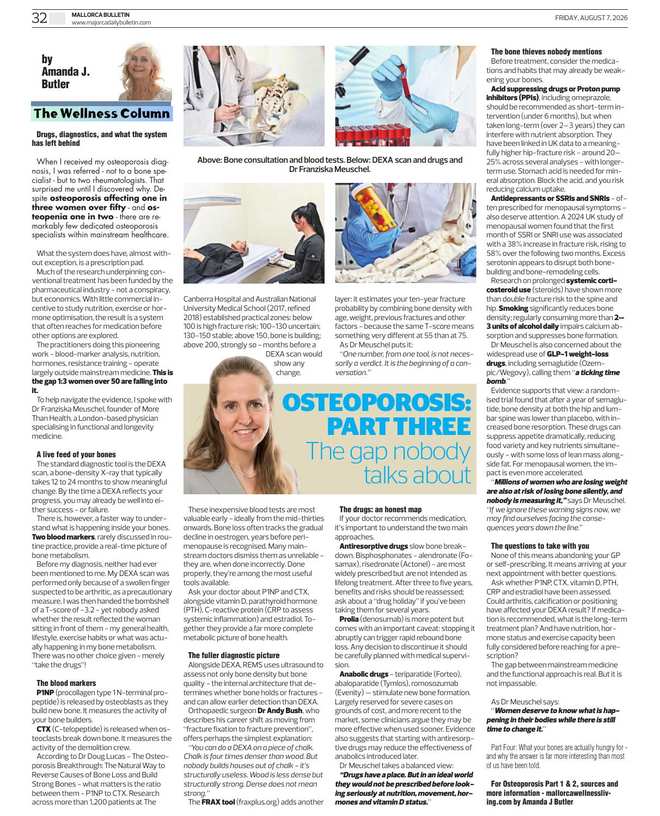
A shorter version of this article first appeared in Amanda’s Wellness Column in the Mallorca Bulletin. Read the original as a PDF →
Disclaimer: Amanda is a wellness writer, not a medical professional. This article is for general information only and is not medical advice. Where research is referenced, the sources are linked for you to explore. Always talk to a qualified healthcare professional about your own situation before making any changes, as individual needs vary.

0 Comments