

- Misdiagnosed: the REMS scan story
- What osteoporosis actually is
- The blood tests most doctors never order
- Best foods for bone health
- Hormones and HRT
- Movement and exercise
- Emerging support and technology you are here
From smarter scans to vibration, magnetic fields and light: the new technologies for osteoporosis that are expanding our understanding of bone health.
The future of bone health may not come in a pill bottle. But it won’t replace the barbell either.
That sentence sums up what I’ve learned this year, since a single number turned my world upside down. In November 2025, a DEXA scan gave me a T-score of -3.2: “severe osteoporosis”, a prescription that will only “slow down the deterioration of your bones” and advice to slow down and stop all dangerous sports! For someone who is happiest cycling the country roads of the Tramuntana here in Mallorca, hiking, practising yoga or skiing in the Pyrenees – that felt like a life sentence. Six months later, a different kind of scan told a very different story. It found mild osteopenia and bone strength above average for my age.
Same bones, two very different verdicts. That experience sent me looking at what technology can now tell us about our bones, and what it might do to help them.
“Same bones, two very different verdicts.”Amanda J Butler
What I found is exciting. Some of it is already available, some is still emerging, and some is a glimpse of the future. None of it is a magic bullet. But taken together, it offers women something the standard approach rarely does: more information, more options and more control. In this extended version of my Mallorca Bulletin column, I look at the new technologies for osteoporosis in more depth, including how to use a vibration plate properly, what the research says, and my own experience with LifeWave patches.
Seeing bone more clearly: new scans beyond DEXA
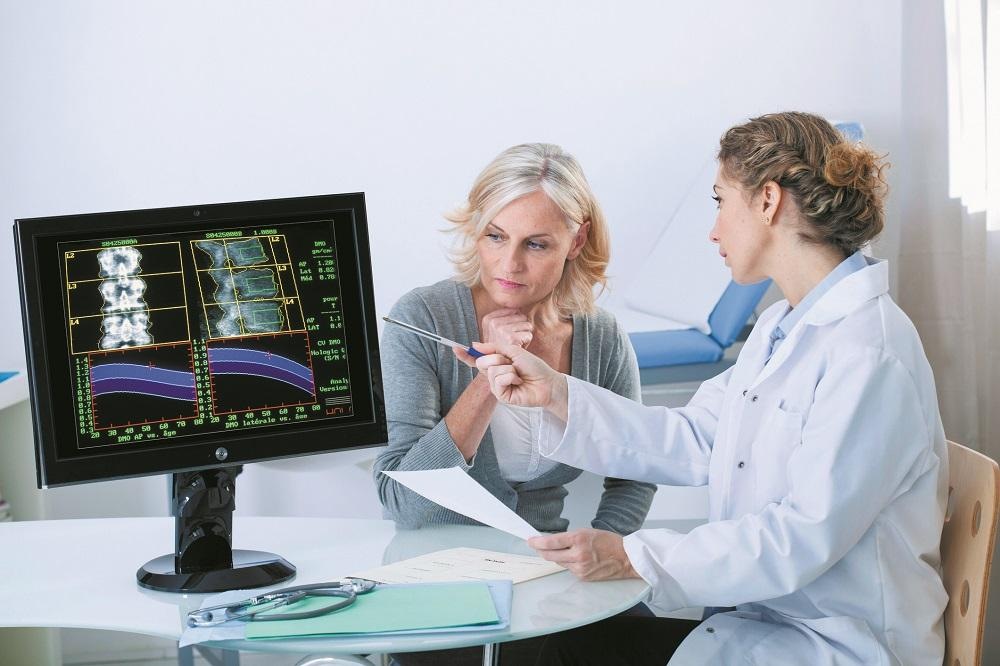
Some of the most useful advances are in diagnosis. DEXA, the standard bone scan, measures bone mineral density using two-dimensional X-ray images. It is valuable, but density is only part of the picture. This number can also be distorted by numerous variables – including arthritis, spinal curvature or the extra bone that builds up around ageing joints, which is why hip and spine results often disagree. And because DEXA measures bone in two dimensions, not three, it can also underestimate bone strength in smaller, slighter women.
As one bone engineer explained it, true density is mass divided by volume, but DEXA divides bone mineral by the flat area it sees. The depth of your bone is simply missing from the calculation. That is why a petite woman with healthy bone can score lower than a larger woman with weaker bone.
Even a well-calibrated DEXA machine has a margin of error, and differences in machines, software, reference populations and positioning can all affect the result. Two scans need to differ by roughly 2.8 to 5.6% before a change can be considered real. I explore this in more detail in What is osteoporosis?.
What is a REMS scan?
REMS (Radiofrequency Echographic Multi Spectrometry) is the ultrasound scan that prompted my reassessment. It uses no ionising radiation and provides bone-density estimates and a fragility score. The mainstream medical profession has yet to embrace it, but it is available privately in the UK and Europe, and increasingly respected by specialists who believe DEXA alone can lead to overmedication. Because it is not confused by arthritis, calcification or spinal curvature in the same way, it can be especially useful when hip and spine DEXA results do not agree. It also has a built-in alert for incorrect positioning: during my own REMS scan, the device beeped whenever the probe moved out of position, prompting the practitioner to adjust it.
Biomechanical CT and AI
Biomechanical CT uses computer modelling similar to that used to stress-test bridges and aircraft. It turns suitable CT images into a virtual stress test, estimating bone strength rather than measuring the actual force that would break your bone. FDA-cleared software is already available in the United States. It simulates a sideways fall on the hip and a compressive load on the spine, and in a large US study it identified more of the women who went on to fracture their hip than DEXA did. It is not yet offered in Spain.
Artificial intelligence can also analyse suitable CT scans taken for other reasons, such as kidney stones, lung checks or abdominal problems, and flag low bone density. These scans already contain detailed information about the spine that usually goes unused. In one large US study, an AI tool developed by NYU Langone Health radiologists analysed more than half a million CT scans from over 280,000 patients. It measured the density of each vertebra and flagged anyone below age- and sex-specific thresholds for review. Reusing existing images means no new scan or extra radiation for that analysis, although a finding may need follow-up. Many women may already have had a scan that could have warned them years earlier.
Bone turnover markers: the blood tests to ask for
Two blood markers are worth discussing too. P1NP and CTX reflect bone formation and breakdown. They can help clinicians monitor treatment response within months, rather than years. An experienced clinician should interpret them alongside scans and fracture risk. There is more on these tests in my article on osteoporosis blood tests. One practical tip: have them taken fasting, first thing in the morning, at the same laboratory each time, as eating or a later appointment can change the result significantly.
The barbell still wins: why loading matters for bone
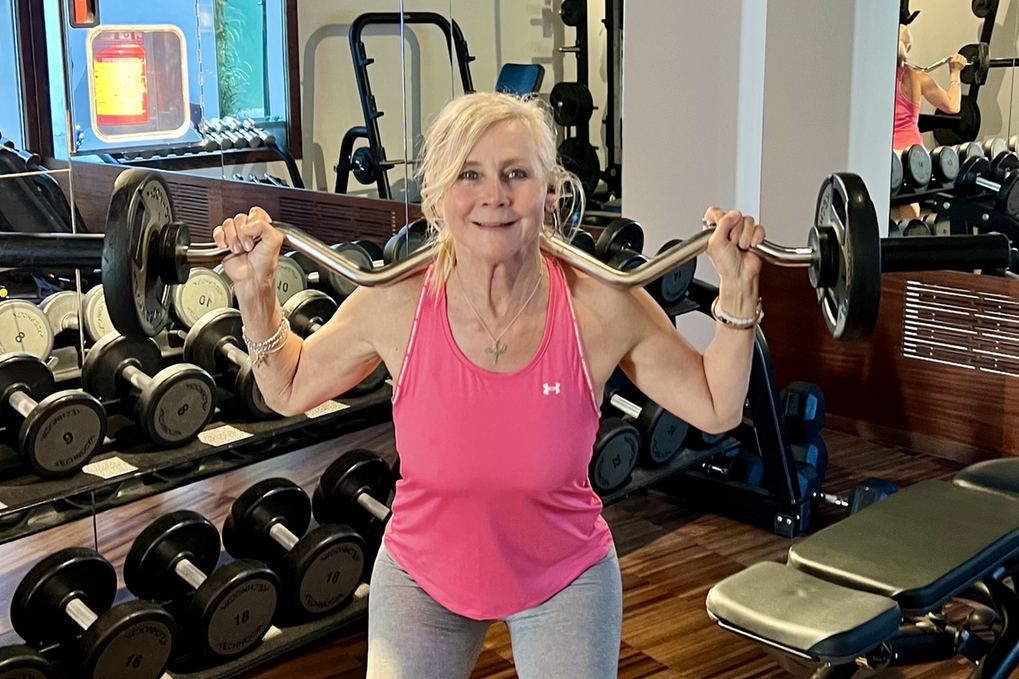
Bone is living tissue that responds to loading through lifting, impact and weight-bearing movement. Appropriately supervised resistance and impact training remains a central part of bone care, as I explored in Part 6 of this series. In the Australian LIFTMOR trial, postmenopausal women with low bone mass gained almost 3% in spinal density in eight months under close supervision. NASA learned the same lesson in reverse: without gravity, astronauts lose bone fast, so resistance training is part of their daily routine in space.
What is exciting is that several new technologies appear to tap into the same signal. Some of them can help women who cannot yet lift safely.
Whole body vibration for osteoporosis: how to use a vibration plate
Whole-body vibration plates, used standing with knees softly bent, have consistently been shown to slow bone loss. They also clearly improve balance, which may matter just as much, since most hip fractures follow a fall.
Over the past few months I have listened to numerous talks on vibration plates, but two detailed interviews stood out on the Dr Doug Show, with orthopaedic surgeon Dr Doug Lucas and with Dr Jason Conviser, an exercise physiologist of more than 35 years and Chief Science Officer of the company behind Power Plate. Here is what I took away.
Stand still for bone, move for muscle
For bone, the advice is to stand on the plate rather than exercise on it. Dr Doug suggests knees slightly bent, around 70% of your weight towards the front of the foot with heels still on the plate, so you feel the vibration travel up through your spine. Once you bend deeply into squats or lunges, the force goes into the muscles instead of the bones. Exercising on a plate is still valuable for strength, flexibility and recovery, but is a different goal.
The settings that matter
- Frequency: both experts place the useful range between about 30 and 40 Hz. Dr Conviser uses 30 Hz with almost all his older and less well clients.
- Amplitude (how far the plate moves): 2 to 4 mm is the sweet spot. Studies at 2 mm mostly showed slower bone loss; at 3 to 4 mm, small gains of 1 to 2%. The strongest study Dr Doug cites, by Ruan in 2008, used a larger 5 mm displacement and reported gains of 4.3% at the spine and 3.2% at the hip.
- Plate type: “triplanar” plates move up and down, side to side and front to back, which feels far gentler than the rocking “teeter-totter” style. That matters, because the best device is the one you will keep using.
- Time: Dr Conviser has seen the bone-building blood marker P1NP rise within three to six months, but only with at least 10 minutes of vibration a day. Two minutes a day is not enough. For older or less mobile clients he recommends 1 minute on, 1 minute off, so around 20 minutes in total, increasing gradually according to fragility.
What results to expect
Patience is part of the prescription. Dr Conviser describes a 2 to 4% improvement in bone density after a year or more as “a gigantic improvement”, because it reverses the downward slope. The balance benefits, on the other hand, can appear within days. A small 2026 study comparing vibration, weighted vests and exercise alone found that, over just eight weeks, the added stimulus improved balance, walking and sit-to-stand tests more than exercise alone.
Who should take care
Vibration is not for everyone. Anyone told not to exercise by their doctor should not use a plate, and people with eye conditions such as retinal problems, very recent surgery or uncontrolled blood pressure should check first. Ringing in the ears or a buzzing head usually means your knees are too straight. After a joint replacement, wait for your surgeon’s clearance; Dr Doug’s own view as a surgeon is to avoid vibration with cemented implants. In the interest of transparency, both experts have links to Power Plate. That said, plenty of other doctors and practitioners share similar research on YouTube.
Osteoboost: a wearable vibration belt
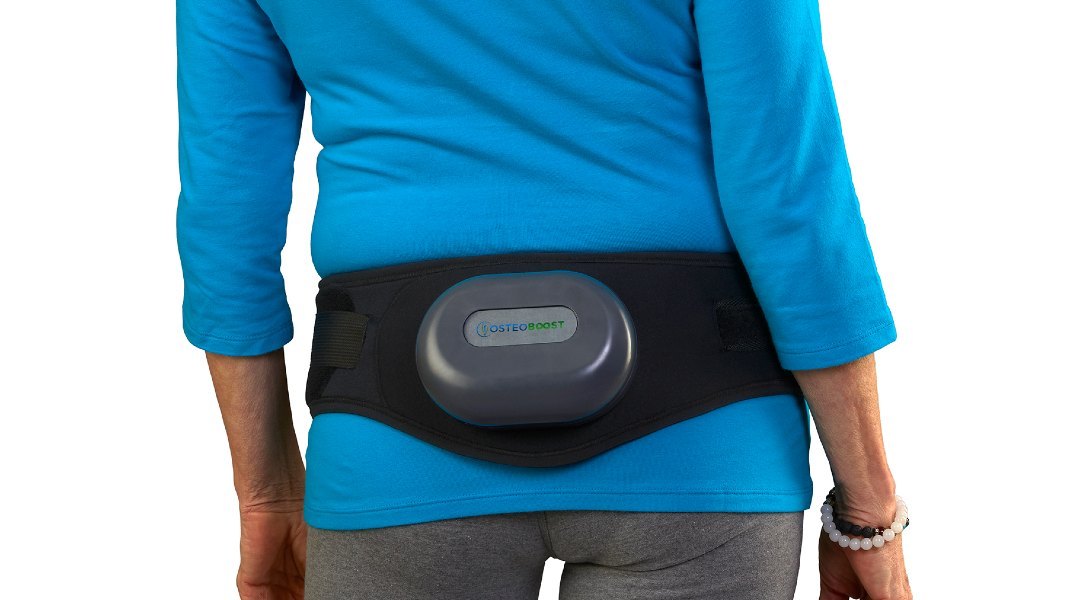
In the US, a wearable vibration belt called Osteoboost has become the first drug-free treatment cleared by the FDA for osteopenia. In its trial, women who wore it regularly lost significantly less bone at the spine and hip. The 12-month trial involved 126 postmenopausal women with an average age of 61, wearing the belt for 30 minutes a day while going about daily life. It is prescription-only and not yet available in Europe.
PEMF for osteoporosis: an old technology with new promise
PEMF (pulsed electromagnetic field therapy) isn’t new. It has been FDA-cleared since 1979 for fractures that fail to heal. Gentle magnetic pulses mimic bone’s natural electrical signal, without any physical load. In one small trial of postmenopausal women, it matched a standard osteoporosis drug over six months, though more research is needed.
Bone is naturally “piezoelectric”: when it is loaded, it generates tiny electrical signals that tell bone cells to strengthen. PEMF recreates that signal with magnetic pulses. Laboratory studies suggest it encourages the cells that build bone while calming those that break it down. Bone studies have mostly used modest settings, around 10 to 75 Hz and 10 to 100 gauss, and the clear message from practitioners is that consistent daily use over months matters more than a powerful device.
Red light therapy for bone health
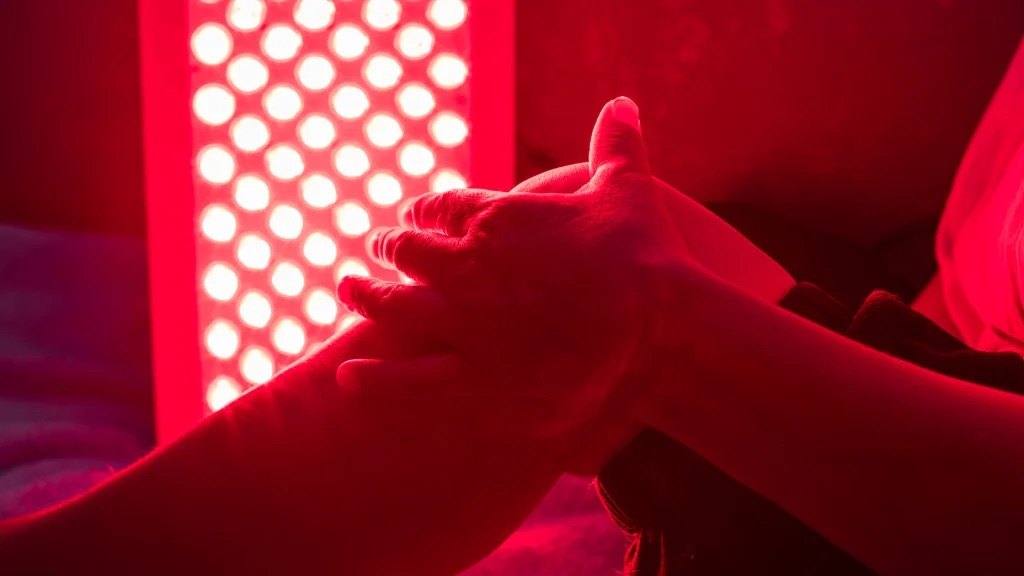
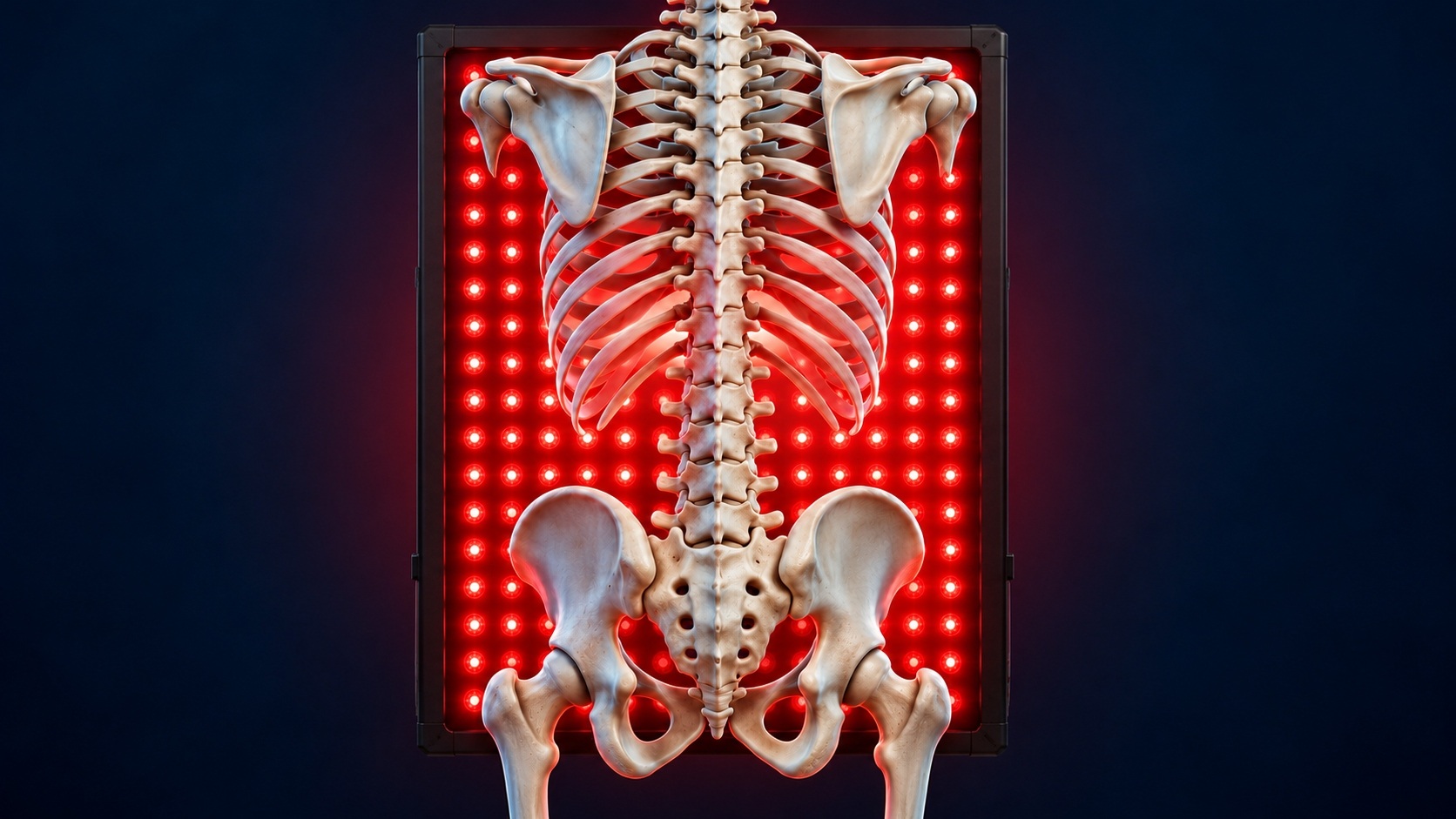
Red and near-infrared light therapy, or photobiomodulation, is also being studied for bone repair. The evidence is strong for bone healing after dental work and fractures. In one year-long Brazilian study, postmenopausal women who exercised under near-infrared light lost no bone in the thigh, while those who exercised without it lost 2.5%. It seems to work best not alone, but as an amplifier of exercise.
For bone, the logic points to near-infrared wavelengths (around 810 to 850 nm), which penetrate deepest, from a panel with independently lab-tested output, used for 10 to 20 minutes after strength training. Avoid devices that add blue light, and always protect your eyes.
A personal note: my experience with LifeWave patches
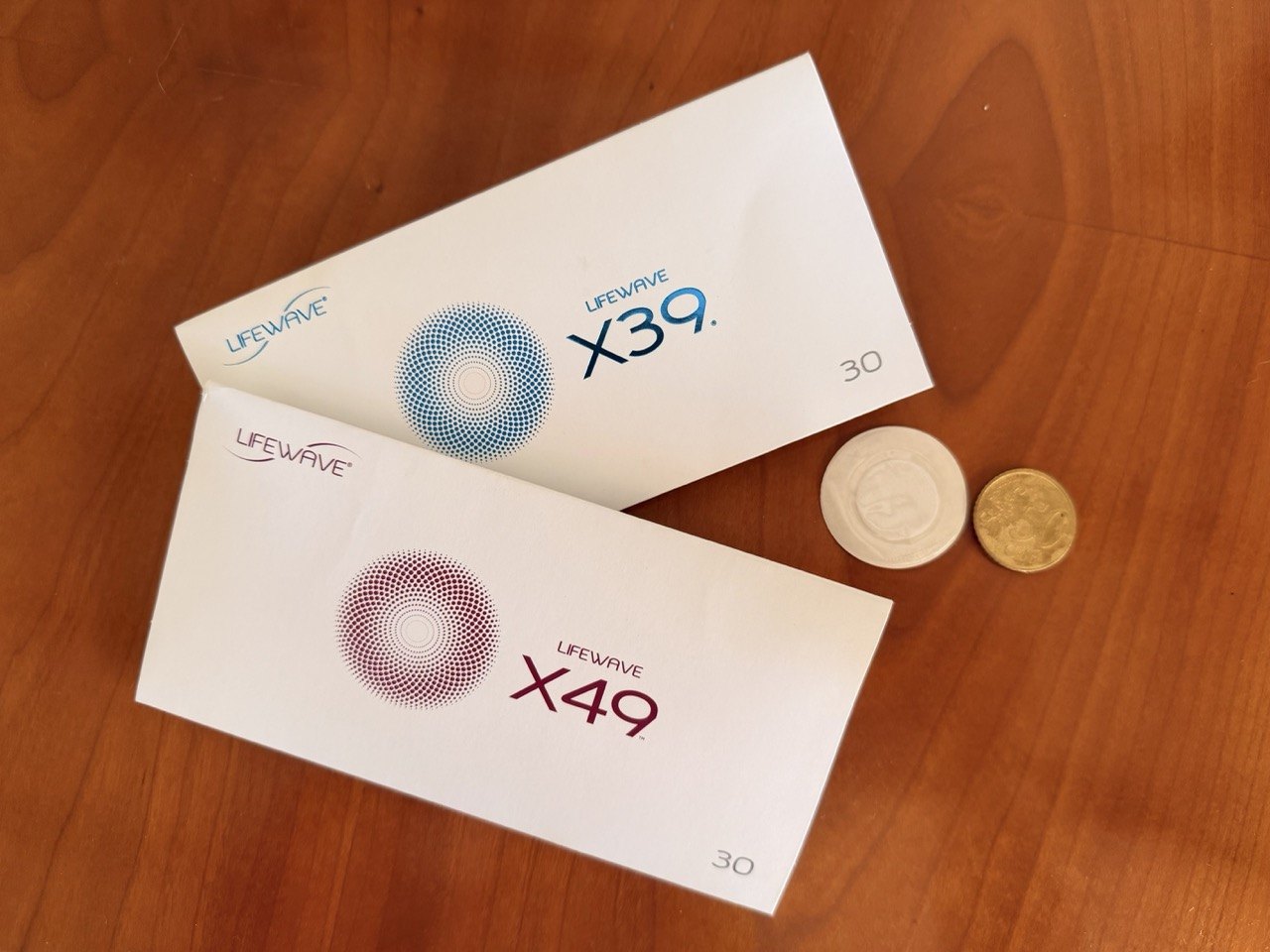
For the past three years I have been using a product called LifeWave X39 and X49, technologically advanced and completely natural, non-transdermal (nothing passes through the skin into the body) photo-therapy patches.
During that time my blood results have improved year on year. As my doctor put it: “Whatever you’re doing differently, keep on doing it.” That is quite unusual at my age, and the patches are the only change to my routine. And my nails and hair, always weak and brittle since childhood, are now growing long and strong. I can’t prove the patches are responsible, but since collagen underpins skin, nails and bone alike, I’ll be watching my bone markers closely.
What are LifeWave patches?
LifeWave was founded in 2004 by American inventor David Schmidt. Its patches contain no drugs or active ingredients and nothing enters the body. According to the company, they work as a form of phototherapy, reflecting specific wavelengths of the body’s own infrared light back into the skin. Each patch is typically worn for around 12 hours a day.
- X39 is the company’s flagship patch. LifeWave says it supports the body’s own production of GHK-Cu, a naturally occurring copper peptide involved in tissue repair and collagen formation, whose levels fall with age.
- X49 is linked by the company to a related copper peptide, AHK-Cu. In its brochures, LifeWave presents it as a wellness product that supports performance, a healthy cardiovascular system, cognitive function, muscle recovery and, alongside a healthy diet and exercise programme, fat loss and bone health.
What does the research say?
The research is at an early stage. A 2023 study of the X49 patch in 22 men aged 40 to 81, published in the International Journal of Sports and Exercise Medicine, reported fitness improvements of 31 to 70% over 60 days alongside a simple exercise programme. However, it had no placebo group, was funded by LifeWave and did not measure bone. A further study of the X39 patch and blood copper peptide levels is registered. In other words, this is exactly the kind of technology I describe below: extremely promising, but without the large, independent trials that only pharmaceutical budgets tend to fund. For now, that means relying on company-funded studies and personal experience.
So I want to be clear: X39 and X49 are not a treatment for osteopenia or osteoporosis, and it has not been shown that they increase bone density or prevent fractures. What I can share is my own experience, and my plan to track it properly with my P1NP and CTX markers and my next scan. I will report back.
“I can’t prove the patches are responsible, but since collagen underpins skin, nails and bone alike, I’ll be watching my bone markers closely.”Amanda J Butler
Disclosure: LifeWave works through referral, so anyone who recommends it, including me, is automatically an affiliate with a discount link. As well as my nails and hair, the patches have helped me with menopause symptoms and chronic back pain from an old injury. If you’d like to know more, you can contact Beverley Pugh, who now focuses her business on LifeWave.
On the horizon
Researchers including a team at Leipzig University have identified a receptor on bone cells, GPR133, that responds to mechanical stimulation. A compound called AP503, which activates it, improved bone in an osteoporosis mouse model. It is years away from human use, but it shows where science is heading: treatments that mimic what exercise does naturally. The same team reports that AP503 also improves muscle strength, which matters because, as every expert I have spoken to agrees, muscle and bone work as a team.
Why you may not have heard of these new technologies for osteoporosis
Large clinical trials cost millions and are almost always funded where there is a patentable drug and a strong financial return. Vibration, light and magnetic fields have no pharmaceutical sponsor because the cost of a sufficiently large independent study usually outweighs any commercial return. Much of the evidence therefore comes from smaller studies, clinical experience and companies specialising in these technologies. That is a reason to ask questions, not a reason to dismiss them. Absence of a large trial is not proof that something doesn’t work.
“Absence of a large trial is not proof that something doesn’t work.”Amanda J Butler
Where this leaves us
None of these technologies replaces strength and balance training, adequate nutrition, the appropriate supplements, sleep, stopping smoking and limiting alcohol, and, for many women, hormone replacement therapy. Better imaging and specialist interpretation can help you understand your real fracture risk before considering medication. Blood markers can show within months whether your efforts are paying off. And vibration, PEMF and light may give your bones an extra nudge in the right direction.
If you are considering any of them, talk to your doctor, ask for your P1NP and CTX before you start, and test again three to six months later. Work alongside your clinician and help your own body show you what works.
The pill bottle has its place, for women correctly assessed as high risk, or less able to exercise. So does the barbell. But for the first time, we have a growing toolkit in between, and it is well worth knowing about.
Good news for women in Mallorca
I’m delighted that this series has sparked a local conversation too. After I raised my differing scan results with Clínica Juaneda, and asked them to formally record that my DXA result appeared to be a false positive, I was both surprised and impressed to hear they are upgrading their equipment, with new DXA scanners and two new tools: a Trabecular Bone Score (TBS), which gives an indication of the micro-architecture of the spine, and 3D-Shaper, which builds a three-dimensional model of the hip from DXA images. Both add valuable information to standard density measurements. Of everything this journey has brought, that response is the one I am proudest of, because it means women in my community will be much better served. Something to celebrate!
I will continue to research the latest updates and innovations in bone health and will keep my blogs updated – so watch this space.
Key Takeaways
- DEXA measures density, not strength, and can be distorted by arthritis, spinal curvature and body size.
- REMS, biomechanical CT, TBS and 3D-Shaper add information on bone quality and fragility.
- P1NP and CTX blood tests show within three to six months whether your approach is working.
- Supervised resistance and impact training remains the foundation of strong bone health.
- For bone, stand on a vibration plate with knees softly bent at around 30 to 40 Hz and 2 to 4 mm, building to about 10 minutes of vibration.
- PEMF and near-infrared light are promising additions, best used alongside exercise.
- Lack of large trials often reflects funding, not failure: ask questions, track your own results, and work with your clinician.
I would love to hear which parts of this series you have found most valuable, whether you feel I’ve missed anything, and which topics you’d like me to explore in more depth, so do share it in the comments below.
Read & add your comment ↓Further Inspiration:
Why I rethought my training · Seeds for collagen and strength · Best nuts for bone health

As featured in the Mallorca Bulletin
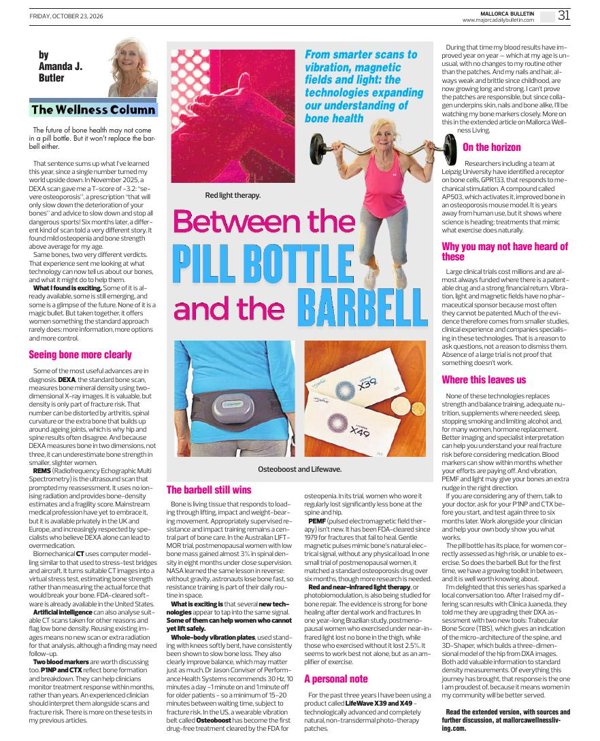
A shorter version of this article first appeared in Amanda’s Wellness Column in the Mallorca Bulletin. Read the original as a PDF →
Sources and Further Reading
Key sources are linked within the article. These are the supporting references and further viewing.
- High-intensity resistance and impact training improves bone mineral density and physical function in postmenopausal women with osteopenia and osteoporosis: the LIFTMOR randomised controlled trial. Watson et al., Journal of Bone and Mineral Research, 2018.
- Is jumping good for osteoporosis? The Dr Doug Show, YouTube.
- Red light therapy and bone health, with Scott Chaverri. The Dr Doug Show, YouTube.
- Red light therapy, with Ari Whitten. Margie Bissinger, YouTube.
- FDA clears wearable vibration belt for postmenopausal women with osteopenia. Healio, 2024.
- Nanox nets FDA clearance for osteoporosis and spine fracture AI. Fierce Biotech.
- Two-part study of the X39 patch on circulating GHK and GHK-Cu levels in healthy adults. ClinicalTrials.gov.
Frequently Asked Questions
Can osteoporosis be treated without medication?
For many women, yes, alongside medical advice. Supervised resistance and impact training, good nutrition, sleep and, where appropriate, hormone therapy are the foundations, and technologies such as vibration, PEMF and red light may add further support. Women at high fracture risk may still need medication, so decisions should be made with a knowledgeable clinician.
What is the difference between a DEXA scan and a REMS scan?
DEXA uses low-dose X-rays to measure bone mineral density in two dimensions. REMS uses ultrasound, with no ionising radiation, and also gives a fragility score. REMS is less affected by arthritis and spinal curvature, so it can help when DEXA results seem inconsistent.
Does whole body vibration help osteoporosis?
Studies show vibration plates mainly slow bone loss, with small gains at higher amplitudes, and clearly improve balance, which helps prevent falls. For bone, stand on the plate with knees softly bent at around 30 to 40 Hz, building up to about 10 minutes of vibration.
Is PEMF therapy approved for osteoporosis?
PEMF has been FDA-cleared since 1979 for fractures that fail to heal, but not specifically for osteoporosis. Small trials in postmenopausal women are encouraging, and larger studies are still needed.
Can red light therapy improve bone density?
The strongest evidence is for bone healing after dental work and fractures, and it is reasonable to hope some of that benefit carries across to general bone loss, although this has yet to be proven. In postmenopausal women, a small year-long study found near-infrared light combined with exercise prevented the bone loss seen with exercise alone. It appears to work best as an addition to exercise.
Where can I get a bone density scan in Mallorca?
DEXA scanning is available through public and private clinics in Mallorca, and Clínica Juaneda is adding Trabecular Bone Score and 3D-Shaper to its DXA assessment. Ask your doctor or clinic which tools they offer, and whether bone turnover blood tests can be added.
Are drug-free bone health technologies more sustainable?
Many are reusable devices with no ongoing medication requirements, and they support an active, outdoor lifestyle. Choosing durable, well-made equipment you will use for years, and pairing it with time outdoors walking and moving in the natural landscape, is a gentler choice for both body and planet.
Disclaimer: This article is for general information only and is not medical advice. Where research is referenced, the sources are linked for you to explore. Always talk to a qualified healthcare professional about your own situation before making any changes, as individual needs vary.
0 Comments